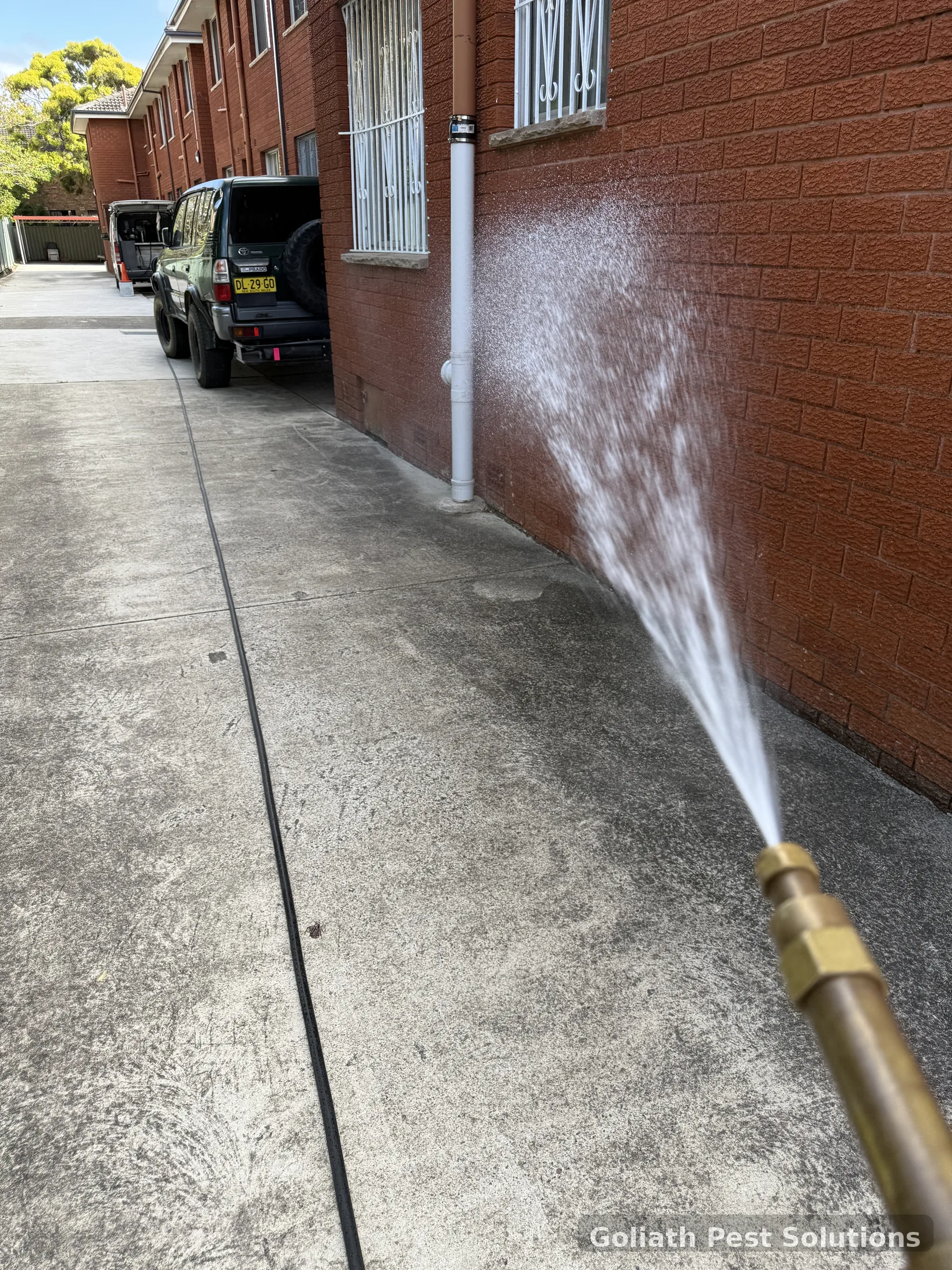
A post-construction termite barrier is not simply a line drawn around a house. For Greenwich properties, the practical design depends on accessible soil, concrete, paving, subfloor areas, service penetrations, construction junctions and any places where continuity is difficult. Goliath Pest Solutions can assess those details before finalising a treatment scope.
Genuine Goliath Pest Solutions field photography. Image location is not represented as Greenwich unless specifically documented.
Two homes can use the same termiticide or treatment concept and still require very different installation work. One perimeter may provide direct soil access; another may involve concrete drilling, paving, narrow side access, retaining features or subfloor interfaces. The proposal should describe how those conditions are handled.
That is why like-for-like quote comparison needs more than a product name. Treatment length, drilling pattern, trenching, rodding, accessible internal foundation work, exclusions and inspection conditions can materially change what is actually being supplied.

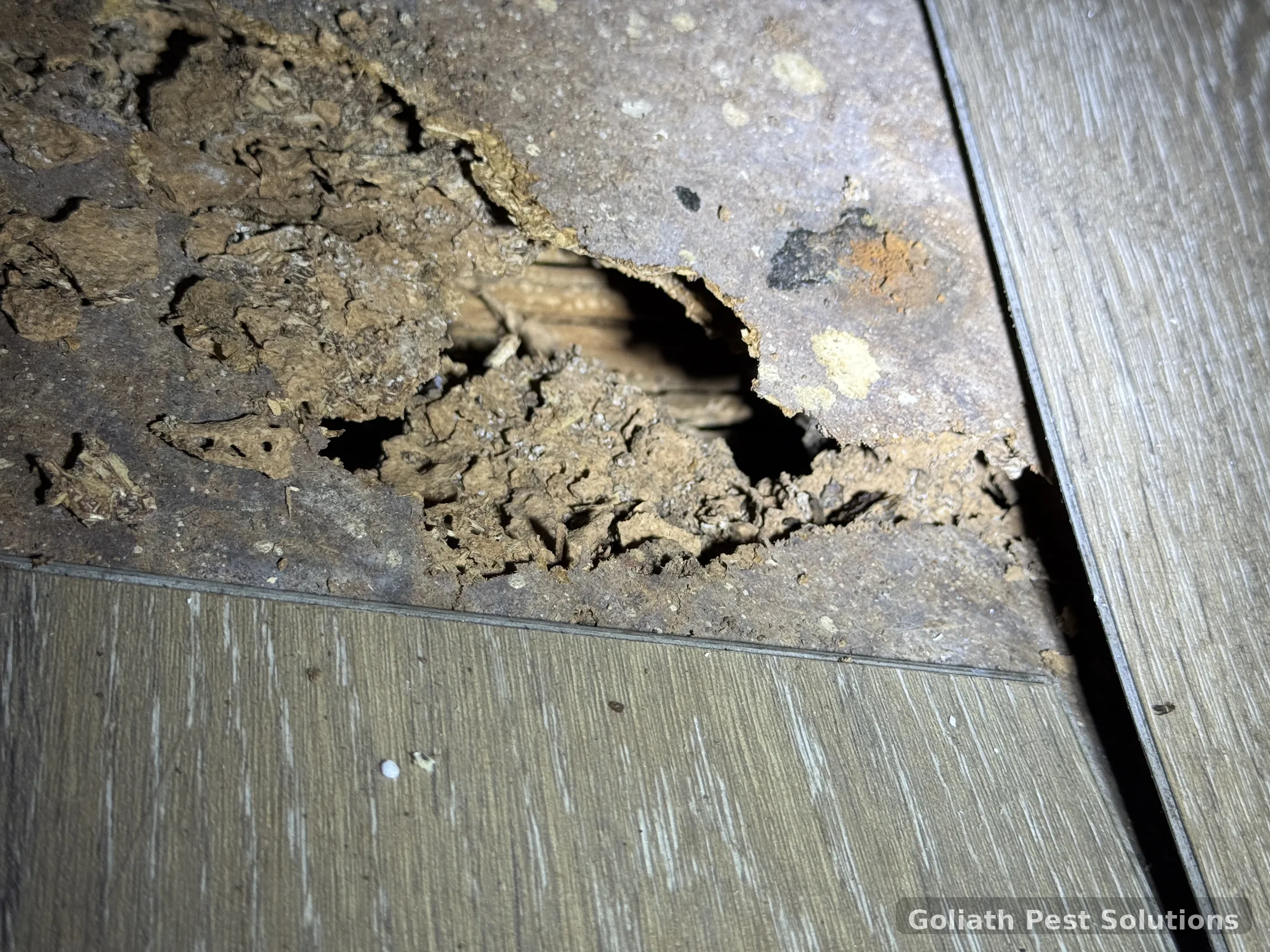
Supporting field image used to explain inspection or treatment considerations. It is not presented as a photographed job in Greenwich.
The goal is a coherent treatment plan that can be installed safely and documented clearly, not a generic perimeter number copied from another property.
Assess trenching or other soil-treatment methods and how the zone connects to adjacent sections.
Consider drilling/injection design, service locations, finishes and reinstatement expectations.
Review accessible foundations, piers, walls and soil areas where treatment may form part of the design.
Document inaccessible sections, built-over areas, drains, services or other features affecting continuity.
A barrier quote should start with enough site information to identify the intended treatment path. That may involve measuring relevant perimeters, checking construction interfaces and confirming where soil, concrete or subfloor access exists.
If termites are already active, that finding needs separate attention. A long-term chemical barrier and active colony treatment can be related parts of a program, but they are not interchangeable objectives.
A well-described barrier proposal should allow another informed person to understand the treatment path. If the scope only says “full barrier” without showing what that means on the property, ask for more detail.
See our Termite Inspections page for the broader inspection process, or Active Termites if live activity has already been found.
A Greenwich barrier may use several installation techniques to create the intended treated zone. The appropriate combination depends on construction and access, and the quote should identify the main methods rather than hiding them behind one line item.
| Situation | What may be assessed | Useful next question |
|---|---|---|
| Soil beside foundations | trenching, soil treatment and backfilling around accessible sections | How is the treated soil zone installed and connected to adjacent areas? |
| Concrete paths or slabs | drilling spacing, injection approach, services and reinstatement | Which concrete sections are included and how will drilled areas be finished? |
| Restricted soil access | rodding or other approved installation approach where appropriate | How will the contractor confirm treatment reaches the intended area? |
| Active termites plus barrier | sequence of colony treatment and longer-term protection | Which work addresses live activity and which work provides future risk management? |
Where a soil-treated zone is appropriate, read our Chemical Barriers guide. If a previous system is uncertain, the unknown barrier or treatment history guide explains what old records and visible evidence can and cannot establish.
The totals may differ because the scopes are not actually the same. One contractor may include more drilling, subfloor work, internal foundation treatment, monitoring or follow-up. Another may exclude difficult sides, assume direct soil access or use a different warranty structure.
Use our Post-Construction Termite Barrier and Chemical Barriers pages to understand common installation concepts before comparing the proposals.
Then check each quote line by line: treatment areas, method, product, quantities where relevant, exclusions, follow-up, inspection obligations and what happens if the site conditions differ. That is the basis of a genuine like-for-like comparison.
If you upload a written quote, we can focus on whether the proposed work is comparable rather than simply trying to undercut a number. The objective is to make sure a lower price is not achieved by quietly removing treatment areas or service obligations.
Where a competitor’s proposal is vague, we may need photos, measurements or an inspection before confirming a true equivalent scope. That protects both the homeowner and the technician from comparing two different jobs as if they were identical.
Already have a written proposal? Use Termite Quote Beat to submit it for a like-for-like review. If price is still the main uncertainty, our Termite Treatment Cost page explains why construction, access and treatment scope can materially change a quote.
These pages help keep the Sydney service-area structure connected without implying that Goliath operates a separate office in each suburb.
No. The installation method depends on soil, concrete, paving, subfloor construction and access. Some properties use a combination of methods.
No. Price alone does not establish quality. Compare treatment areas, method, product, exclusions, follow-up and warranty conditions before deciding.
A barrier may form part of a broader program, but active termite treatment should be specifically addressed in the proposal rather than assumed.
Yes. Upload the written proposal. We can compare the treatment scope and identify details that need clarification before a like-for-like price comparison.
NSW Government lists chemical barriers among termite-management systems and emphasises using protection together with regular inspection: Home building safety and standards. NSW EPA explains pest-management technician licensing: NSW EPA licensing guidance.
These sources provide general guidance. A treatment recommendation still needs to be based on the construction, accessible evidence and conditions at the individual property.
Upload the written quote or arrange a site assessment. We can compare the actual treatment path, installation work and ongoing conditions rather than relying on the words “full barrier” alone.
RELATED TERMITE RESOURCES
If you are comparing termite work for a Greenwich property, use these pages to move from inspection or active activity into the appropriate treatment and quote-review pathway.
Find guides, treatments, standards, report help and Sydney service areas.
Compare treatment methods, learn what inspections involve and see genuine termite-management work completed by Goliath Pest Solutions.
Enter your postcode and we’ll check whether it falls within our standard service area from Mortlake.